MemoHoney Official Website › Blog › Niacin And Memory
Niacin: The One Ingredient On This Bottle With A Memory Paper Trail
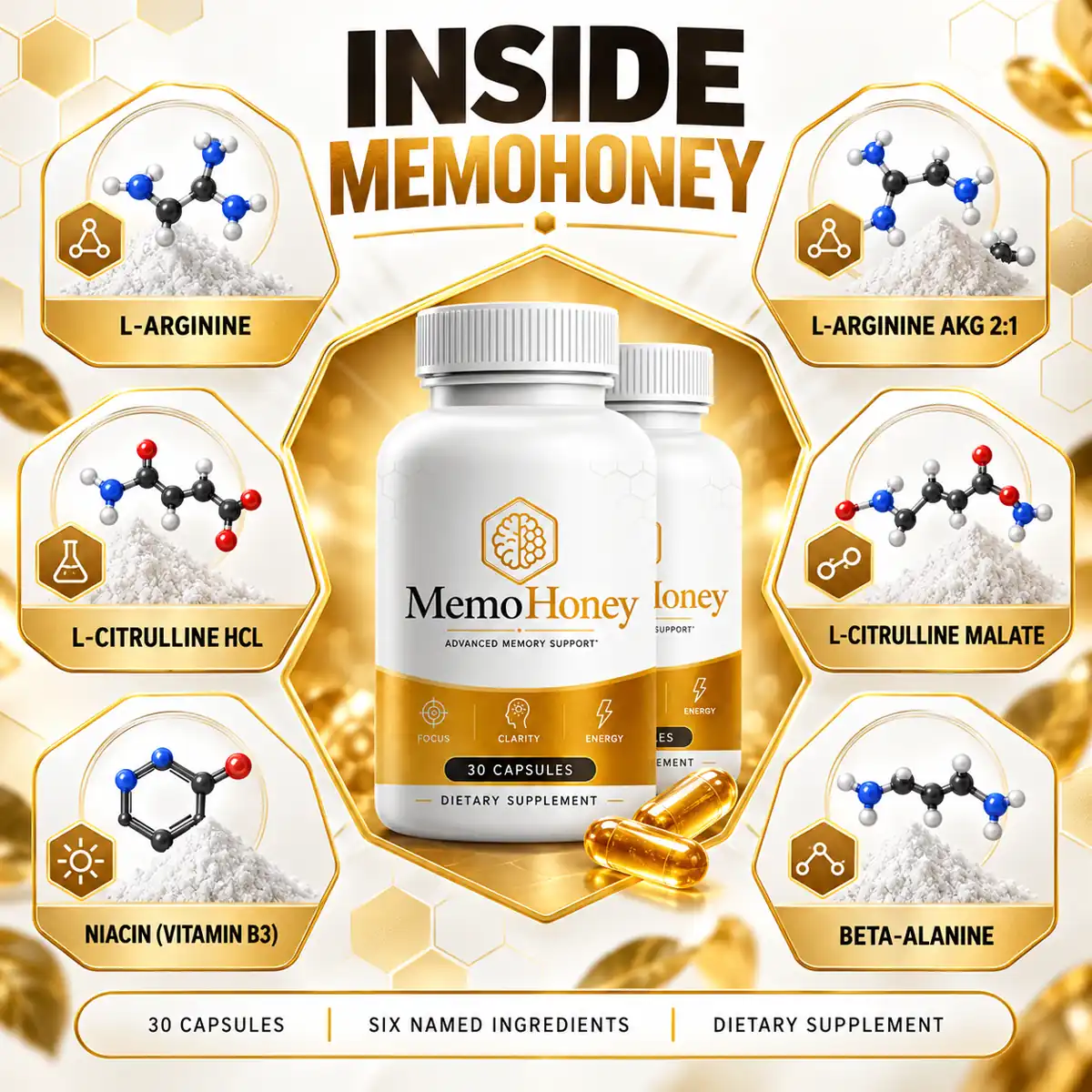
Five of MemoHoney's six ingredients are amino acids borrowed from sports nutrition. The sixth is a vitamin with a published requirement, a published ceiling, and a large observational study behind it — and it is the ingredient where the missing amount matters most.
- Niacin is vitamin B3, converted in the body to the NAD coenzymes that carry electrons through nearly every energy-producing reaction.
- Severe deficiency causes pellagra, whose classical triad is dermatitis, diarrhoea and dementia. The link between this vitamin and cognition is real at the bottom end.
- The adult RDA is 16 mg niacin equivalents a day for men and 14 for women. The tolerable upper intake level is 35 mg a day.
- The strongest cognitive evidence is observational and about diet: 3,718 older adults, higher niacin intake associated with less incident Alzheimer's disease.
- At pharmacological doses niacin is a drug with real harms, and this bottle prints no amount at all.
What niacin does
Niacin is the common name for a pair of compounds, nicotinic acid and nicotinamide, which the body converts into nicotinamide adenine dinucleotide and its phosphate — NAD and NADP. Those two coenzymes carry electrons through most of the reactions that release energy from food, and the brain is one of the most energy-hungry organs in the body.
The body can also make niacin from tryptophan, which is why intakes are expressed in niacin equivalents rather than in plain milligrams: 60 mg of dietary tryptophan counts as roughly 1 mg of niacin.
It is present in meat, fish, wholegrains, legumes and, in much of the world, in fortified flour and cereal. Deficiency in a country with a fortified food supply is uncommon and is usually secondary to something else: alcohol use disorder, malabsorption, bariatric surgery, or a very restricted diet.
| Figure | Amount | What it is |
|---|---|---|
| Adult RDA, men | 16 mg NE/day | The intake that meets the needs of nearly all healthy adult men |
| Adult RDA, women | 14 mg NE/day | The same, for women |
| Tolerable upper intake level | 35 mg/day | The highest daily intake likely to pose no risk, set on flushing |
| A pharmacological dose | 1,000–2,000 mg/day | The range used in lipid trials. A drug dose, not a supplement one. |
RDA and upper limit from the Institute of Medicine's dietary reference intake chapter on niacin, read in full. NE means niacin equivalents, which allow for conversion of tryptophan.
The cognitive evidence, and exactly what it is
There are three quite different bodies of evidence here and conflating them is how this vitamin gets oversold.
Deficiency: strong, and not about supplements
Pellagra's classical triad is dermatitis, diarrhoea and dementia, and the third of those is real and reversible. That establishes that the brain needs niacin. It says nothing about somebody whose intake is already adequate, which in a fortified food supply is most people.
The observational cohort: the strongest signal there is
The Chicago Health and Aging Project studied a geographically defined community of 6,158 residents aged 65 and over between 1993 and 2002. Nutrient intake was assessed by food frequency questionnaire; 3,718 participants had dietary data and at least two cognitive assessments over a median 5.5 years.
Energy-adjusted niacin intake was associated with a lower risk of incident Alzheimer's disease across the quintiles, adjusted for age, sex, race, education and ApoE status, and higher food intake of niacin was associated with a slower annual rate of cognitive decline. The authors' conclusion was that dietary niacin may protect against Alzheimer's disease and age-related cognitive decline.
That is a well-conducted observational study and it is the best cognitive evidence any ingredient on this bottle has. It is also observational: people who eat more niacin eat differently in a hundred other ways, and the association was strongest for niacin from FOOD.
Pharmacological doses: a drug, with drug-sized harms
At a thousand milligrams a day and above, niacin is a lipid-modifying drug rather than a vitamin. HPS2-THRIVE randomised 25,673 high-risk patients to extended-release niacin with laropiprant and found serious adverse effects and no reduction in vascular events; the detailed adverse-event analysis catalogued them. A published case report describes hepatotoxicity in somebody who took large doses of niacin for a non-medical reason.
None of that is remotely in reach of a shared daily capsule, and it is quoted here for one reason: niacin is not a vitamin to take casually in an unknown amount.
| What the evidence is | What it shows | What it does not show |
|---|---|---|
| Pellagra | Severe niacin deficiency causes dementia, among other things. | That extra niacin helps somebody who is not deficient. |
| The Chicago Health and Aging Project | In 3,718 older adults over a median 5.5 years, higher dietary niacin intake was associated with less incident Alzheimer's disease and slower cognitive decline. | Causation, or that a supplement reproduces the finding. It measured food. |
| HPS2-THRIVE | 25,673 people randomised to extended-release niacin: serious adverse effects and no vascular benefit. | Anything about supplement doses. This was a pharmacological dose. |
| This bottle | Niacin is named as one of six ingredients. | How much is in it. No amount is printed anywhere. |
Four rows, three of them real evidence about niacin and none of them evidence about this capsule.
Order MemoHoney with the niacin question understood
A vitamin with a real cognitive literature, a real ceiling, and no printed amount on this bottle. Sixty days to decide, and a good reason to add up the rest of your cupboard first.
Two bottles $158 · six bottles $294 · 60-day money-back guarantee
Order MemoHoney On The Official WebsiteOne capsule a day · 30 per bottle · lot MEM-26/ME-7725
The flush, and how to tell it from the tingle
Two ingredients on this bottle can produce a sensation and they are frequently confused.
The beta-alanine tingle is paraesthesia: a prickling across the face, scalp, neck or hands, starting ten to twenty minutes after a dose and fading inside the hour. It is dose-related and benign.
The niacin flush is different and looks worse. It is a genuine reddening of the skin with warmth and sometimes itching, mediated by prostaglandin release, described in a 2024 review of the mechanism. It is more likely with nicotinic acid than with nicotinamide, and it is the adverse effect on which the 35 mg upper intake level was set.
Neither is dangerous. Knowing which one you are experiencing is worth something, because a flush is a hint about how much niacin is in the capsule and the label will not tell you.
- Tingling, prickling, no colour change: beta-alanine.
- Reddening, warmth, sometimes itching: niacin.
- Both start within twenty to thirty minutes and both fade.
- Taking the capsule with food blunts either one.
- A flush is a reason to add up every other niacin source you take.
Why the missing amount matters most for this ingredient
This is the argument worth carrying away from the post.
For the five amino acids on this bottle, an unprinted amount means a reader cannot tell whether the capsule contains a useful dose — and the arithmetic says it almost certainly does not, because their trial doses are measured in grams.
For niacin, an unprinted amount means something different. A useful dose fits in a capsule easily. So does a dose that takes somebody over the 35 mg ceiling when combined with a multivitamin, a B-complex, an energy drink and a bowl of fortified cereal. A reader trying to stay under the limit has to add up a number that is not there.
That is not an accusation about this product. It is a description of what a name-without-a-number costs a buyer when the ingredient in question has a ceiling.
Add up every other source of niacin you take and keep the total comfortably under 35 mg a day from supplements. If you take a B-complex or a multivitamin alongside this, read its panel — most of them print a niacin figure, and most of them print a large one. If you get a flush, that is information, and it is worth acting on.
The honest position on niacin in this capsule
Of the six names on this bottle, niacin is the one that could most plausibly be present at a dose that does something, and the one with the most respectable cognitive literature behind it. That literature is observational and it is about food.
It is also the one ingredient here with a published ceiling, on a label that prints no amounts. Both of those are true, and a buyer is better served by holding both than by picking whichever one suits the argument.
MemoHoney is a dietary supplement and not a treatment for anything. Memory that has changed in a way you or the people around you have noticed deserves assessment: thyroid disease, B12 deficiency, depression, sleep apnoea, untreated hearing loss and several ordinary prescriptions all present as forgetfulness and all of them are treatable. These statements have not been evaluated by the Food and Drug Administration.
The other five ingredients, with the dose each one's trials used, are on the ingredients page, and the interaction and ceiling detail is on the side effects page.
References
- “Dietary niacin and the risk of incident Alzheimer's disease and of cognitive decline” — Morris MC, Evans DA, Bienias JL, et al, J Neurol Neurosurg Psychiatry 2004;75(8):1093-9 [PMID 15258207].
- Institute of Medicine (US) Standing Committee on the Scientific Evaluation of Dietary Reference Intakes. Niacin. In: Dietary Reference Intakes for Thiamin, Riboflavin, Niacin, Vitamin B6, Folate, Vitamin B12, Pantothenic Acid, Biotin, and Choline. Washington (DC): National Academies Press; 1998. Adult RDA 16 mg NE/day (men) and 14 mg NE/day (women); Tolerable Upper Intake Level 35 mg/day, set on flushing. https://www.ncbi.nlm.nih.gov/books/NBK114304/
- “Niacin-induced flushing: Mechanism, pathophysiology, and future perspectives” — Javaid A, Mudavath SL, Arch Biochem Biophys 2024;761:110163 [PMID 39322100].
- “Effects of extended-release niacin with laropiprant in high-risk patients” — HPS2-THRIVE Collaborative Group, Landray MJ, Haynes R, et al, N Engl J Med 2014;371(3):203-12 [PMID 25014686].
- “Serious Adverse Effects of Extended-release Niacin/Laropiprant: Results From the Heart Protection Study 2-Treatment of HDL to Reduce the Incidence of Vascular Events (HPS2-THRIVE) Trial” — Haynes R, Valdes-Marquez E, Hopewell JC, et al, Clin Ther 2019;41(9):1767-1777 [PMID 31447131].
- “Hepatotoxicity upon using niacin to pass a drug test: A case report” — Durham SH, Covington EW, Clemmons KJ, J Am Pharm Assoc (2003) 2018;58(5):564-567 [PMID 29941333].