MemoHoney Official Website › Blog › Beta-Alanine And Memory
Beta-Alanine And Memory: The 2,400 mg Question
Beta-alanine is the strangest name on this bottle and the only one with randomised cognitive trials behind it. Both of them used 2.4 grams a day for ten weeks, and what they found is more interesting, and more limited, than either the marketing or the scepticism suggests.
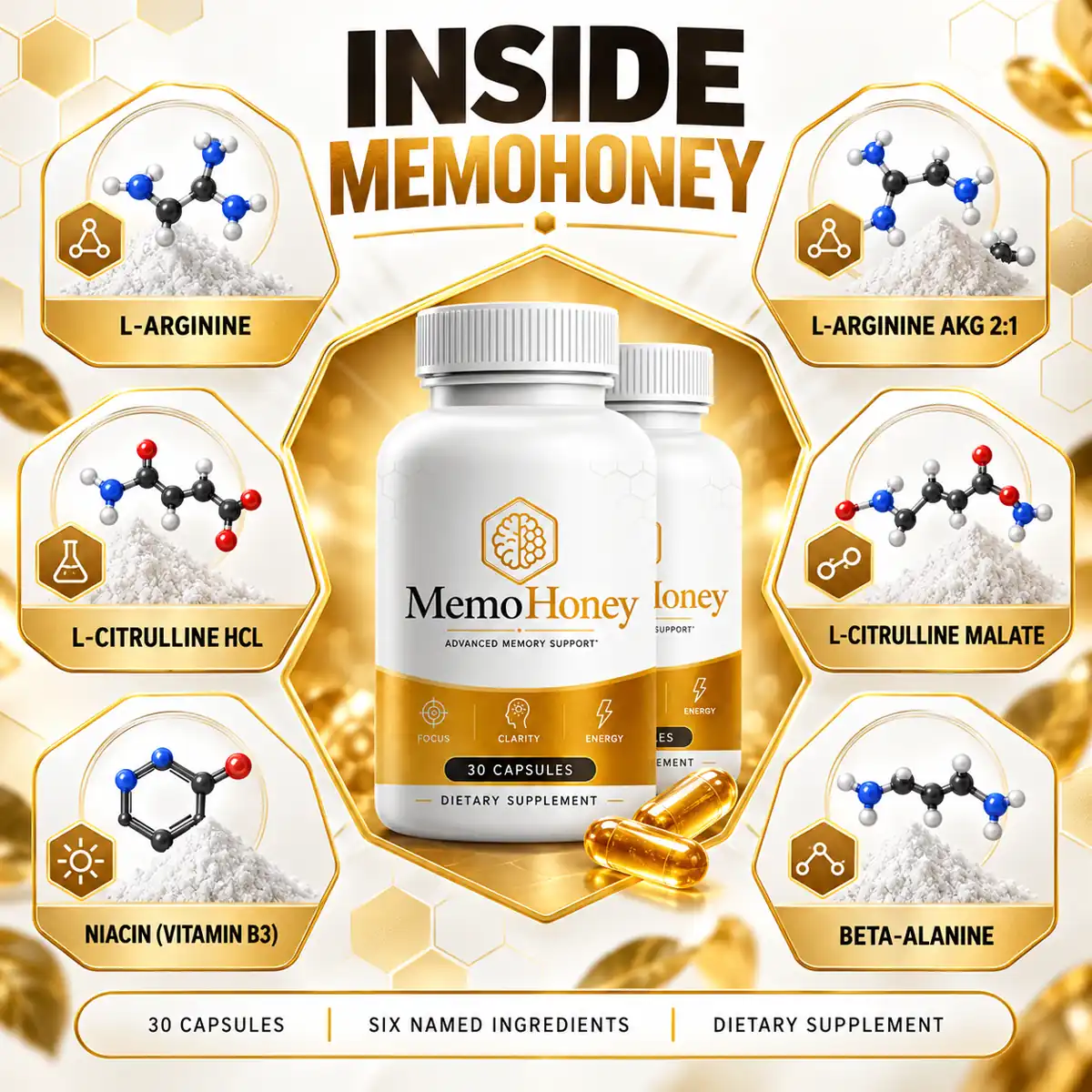
- Beta-alanine is the rate-limiting precursor of carnosine, a buffer found in muscle and in brain tissue. It is a sports-nutrition staple.
- Two randomised trials have tested it for cognition in older adults. Both used 2.4 grams a day for ten weeks.
- In the whole group of 100, the screening score did not change. In the participants who scored at or below normal to begin with, it did.
- A follow-up at the same dose found imaging changes in the hippocampus and amygdala in ten analysable participants.
- 2,400 mg a day is three or more capsules' worth of total fill, before the other five ingredients get any.
What beta-alanine is, and what it usually does
Of the twenty-odd amino acids, beta-alanine is one the body never files into a protein chain — it is non-proteinogenic. Its job instead is to combine with histidine to form carnosine, and it is the rate-limiting step in that reaction, which is why supplementing beta-alanine raises tissue carnosine and supplementing carnosine largely does not.
Carnosine is a pH buffer. In skeletal muscle it mops up the hydrogen ions produced during hard exercise, which is the entire basis of beta-alanine's reputation in sport. The International Society of Sports Nutrition position stand is the standard reference for that use, and it is a well-established one.
Carnosine is also present in brain tissue, and it has antioxidant and carbonyl-scavenging properties in the laboratory. That is the thread somebody followed to arrive at a cognition trial, and it is a reasonable thread rather than a marketing invention.
The two cognition trials, side by side
They come from the same group and they are the entire randomised literature on this question.
| Ostfeld 2023, Nutrients | Ostfeld 2024, Exp Gerontol | |
|---|---|---|
| Participants | 100 older adults, mean age 70.6 | 20 randomised, 10 analysable (6 beta-alanine, 4 placebo) |
| Dose | 2.4 g/day | 2.4 g/day |
| Duration | 10 weeks, with testing at baseline, midpoint and week 10 | 10 weeks |
| Primary measures | Montreal Cognitive Assessment, Stroop, mood and physical function | Blood markers, MRI including diffusion tensor imaging |
| Whole-group cognitive result | No difference in MoCA score (p = 0.19) | Only the at-or-below-normal participants were analysed |
| Subgroup result | In participants scoring at or below normal at baseline: +13.6% at midpoint, +11.8% at week 10 against placebo | Greater change in fractional anisotropy in right hippocampus and left amygdala |
| Other findings | Geriatric depression score fell in the beta-alanine arm. No difference in mood scores, anxiety, grip strength or sit-to-stand. | No difference in BDNF, CRP, TNF-alpha or GFAP |
Both records were retrieved from PubMed and the figures read from their abstracts. Neither trial studied this product.
What the 2023 trial actually showed
The headline result is a null one and it deserves to be stated first. Across 100 older adults, ten weeks of 2.4 grams a day of beta-alanine did not change the Montreal Cognitive Assessment score compared with placebo.
The subgroup result is the interesting one. Among participants whose baseline MoCA score was at or below the normal cut-off — that is, people already showing some impairment on a screening test — the beta-alanine arm improved significantly at both the midpoint and week ten. Depression scores in that arm fell too.
A subgroup finding is weaker evidence than a whole-group one, and anyone reading this should hold it loosely. What makes it worth reading at all is that the subgroup was pre-specified in the sense that it is a clinically meaningful cut-off rather than one found by trawling, and that the follow-up study went looking for a mechanism rather than for a bigger effect.
What the 2024 imaging study adds, and what it does not
The follow-up gave the same 2.4 grams a day for the same ten weeks and measured circulating brain inflammatory markers, BDNF and brain morphology including diffusion tensor imaging. Only participants scoring at or below normal were analysed, which left six on beta-alanine and four on placebo.
No blood marker differed. Fractional anisotropy — a measure of white matter tissue organisation — changed more in the beta-alanine arm in the right hippocampus and the left amygdala.
Ten people is ten people. This is a mechanism suggestion in a very small sample and it should be read as a reason to run a larger study rather than as a result. Reporting it any other way would be the thing this website exists not to do.
Order MemoHoney with the beta-alanine evidence in front of you
Two small trials at 2.4 grams a day for ten weeks, an effect confined to people who started at or below normal, and no published amount on this bottle. Sixty days to decide whether the routine suits you.
Two bottles $158 · six bottles $294 · 60-day money-back guarantee
Order MemoHoney On The Official WebsiteOne capsule a day · 30 per bottle · lot MEM-26/ME-7725
The arithmetic nobody in the category wants to do
Both trials used 2,400 milligrams of beta-alanine a day. On its own. Every day. For seventy days.
A standard size 0 capsule holds somewhere between four hundred and eight hundred milligrams of powder depending on how densely the blend packs, and that budget is shared between six named ingredients plus whatever flow agent the filling machine needs.
So the trial dose of beta-alanine alone is at least three capsules' worth of total fill, before arginine, arginine AKG, citrulline HCl, citrulline malate and niacin get any. This is not a criticism of this product specifically — it is true of every once-daily capsule in the category — and it is the reason the missing numbers matter.
| What the trials used | What a capsule can hold | The ratio |
|---|---|---|
| 2,400 mg of beta-alanine a day, alone | 400–800 mg of total fill, shared between six ingredients | At least 3x, and realistically a great deal more |
| Every day, for ten weeks | One capsule a day, for as long as you keep it up | The routine is the part that matches |
| A single ingredient, weighed | Six ingredients, none weighed on the label | Not comparable, and that is the point |
Capsule capacity is a physical property of the shell rather than a claim about this product. The trial figure is from the records above.
- Nothing above proves the capsule is underdosed. Nobody outside the manufacturer knows what is in it.
- What it establishes is narrower: the published trials cannot be reproduced by one capsule a day whatever its contents.
- A buyer is therefore buying a routine and a blend rather than the studies.
- The single change that would settle this is six numbers on a Supplement Facts panel.
What beta-alanine will do that you can feel
One thing, and it is the only self-report signal any ingredient on this bottle offers.
Beta-alanine causes paraesthesia: a prickling or flushing sensation across the face, scalp, neck, chest or backs of the hands, starting ten to twenty minutes after a dose and fading within the hour. A 2019 systematic risk assessment and meta-analysis of oral beta-alanine found it the only consistently reported effect across the literature, and concluded that the doses used in the available research are not associated with harm.
It is dose-related, which makes its presence weakly informative. A capsule that produces a tingle contains enough beta-alanine to cross that threshold. One that never does contains less. That is not a measurement and it is more than the label offers.
- It is harmless and it fades. It is not an allergic reaction.
- Taking the capsule with food usually blunts it.
- Its absence is not evidence that nothing is in the capsule; the threshold varies between people.
- Its presence is not evidence of a cognitive effect and nobody should read it as one.
Where this leaves a buyer
Beta-alanine on a memory bottle is a defensible and slightly unusual choice. It is the only ingredient here that has been tested for cognition in a randomised trial, the effect it showed was in a group that makes sense — people already scoring below normal — and the follow-up went looking for a mechanism rather than for publicity.
It is also present in an unknown amount, in a capsule, at a fraction of the dose both trials used. Both of those sentences are true at the same time, and a reader is better served by holding both than by picking one.
MemoHoney is a dietary supplement and not a treatment for anything. Memory that has changed in a way you or the people around you have noticed deserves assessment: thyroid disease, B12 deficiency, depression, sleep apnoea, untreated hearing loss and several ordinary prescriptions all present as forgetfulness and all of them are treatable. These statements have not been evaluated by the Food and Drug Administration.
The other five ingredients, with the dose each one's own trials used, are on the ingredients page. The timeline that follows from a ten-week trial is on the results timeline.
References
- “Role of beta-Alanine Supplementation on Cognitive Function, Mood, and Physical Function in Older Adults; Double-Blind Randomized Controlled Study” — Ostfeld I, Ben-Zeev T, Zamir A, et al, Nutrients 2023;15(4):923 [PMID 36839281].
- “beta-Alanine supplementation improves fractional anisotropy scores in the hippocampus and amygdala in 60-80-year-old men and women” — Ostfeld I, Zamir A, Ben-Zeev T, et al, Exp Gerontol 2024;194:112513 [PMID 38971131].
- “Comparison of Two beta-Alanine Dosing Protocols on Muscle Carnosine Elevations” — Church DD, Hoffman JR, Varanoske AN, et al, J Am Coll Nutr 2017;36(8):608-616 [PMID 28910200].
- “International society of sports nutrition position stand: Beta-Alanine” — Trexler ET, Smith-Ryan AE, Stout JR, et al, J Int Soc Sports Nutr 2015;12:30 [PMID 26175657].
- “A Systematic Risk Assessment and Meta-Analysis on the Use of Oral beta-Alanine Supplementation” — Dolan E, Swinton PA, Painelli VS, et al, Adv Nutr 2019;10(3):452-463 [PMID 30980076].