MemoHoney Official Website › Blog › Advanced Memory Support Is a Label Claim, Not a Clinical Outcome
Advanced Memory Support Is a Label Claim, Not a Clinical Outcome
The MemoHoney front label says Advanced Memory Support. This guide separates that phrase from disclosed amounts, product evidence and a promise of an outcome.
Start with what the front label actually says
The MemoHoney front label uses the phrase Advanced Memory Support and the three short words Focus, Clarity and Energy. Those are the seller's presentation phrases. They tell a shopper the category being marketed; they do not describe a measured result in a defined group of people.
This distinction is not wordplay. A clinical outcome needs a question, a group, a dose, a comparison and a way to measure the result. A front-label phrase usually does none of that. It may be a reason to open the ingredient panel and the directions, but it cannot be the answer to whether a capsule will improve a person's recall, attention or energy on a particular day.
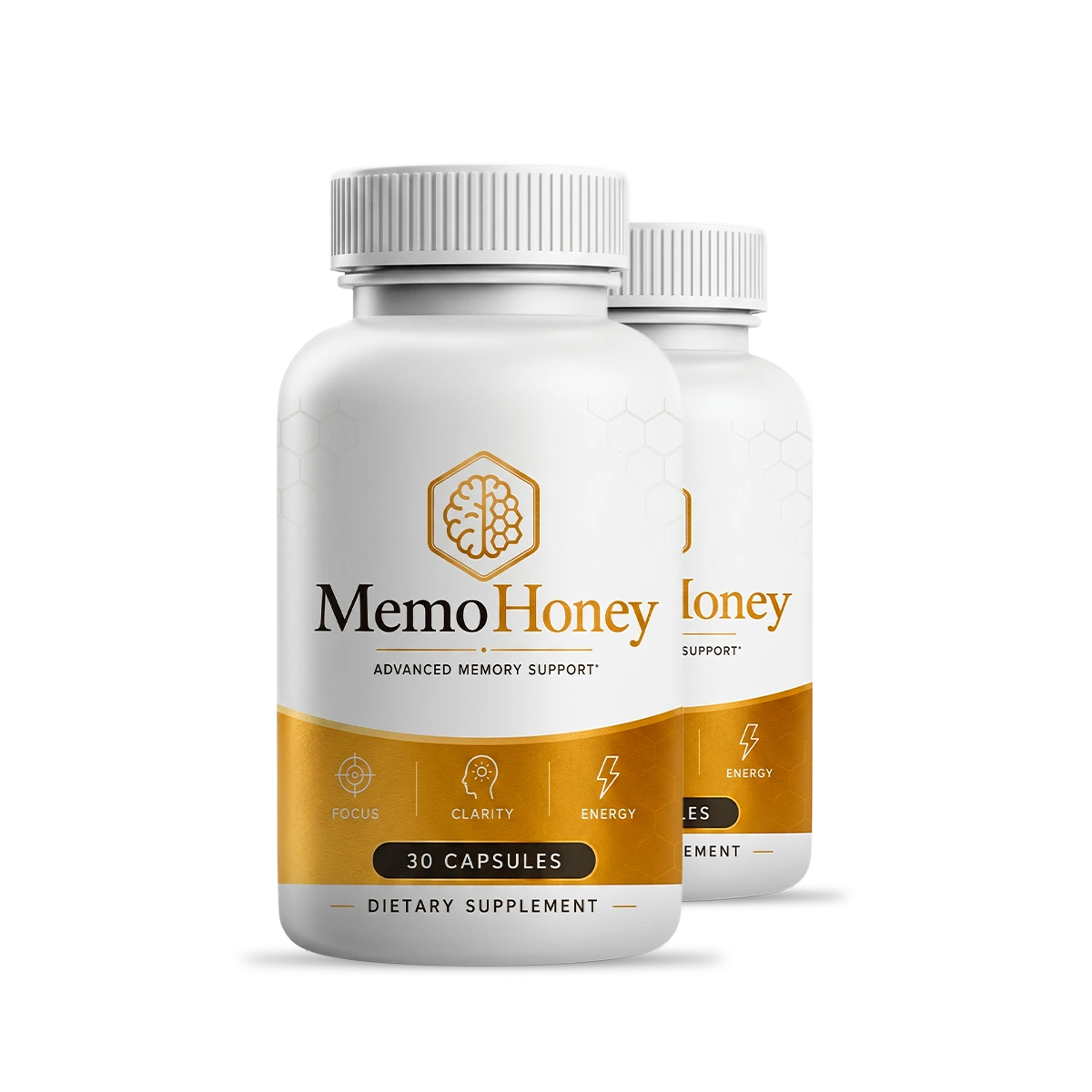
| Label language | What the supplied pack supports | What it does not supply |
|---|---|---|
| Advanced Memory Support | The seller's product category statement | A trial result for MemoHoney |
| Focus, Clarity, Energy | The three front-label marketing words | A defined change, timing or magnitude |
| 30 Capsules | The bottle count | The dose of a named ingredient |
| Dietary Supplement | The product category | FDA approval to treat a disease |
The wording in the first column is transcribed from the supplied MemoHoney pack.
The label also leaves important questions open
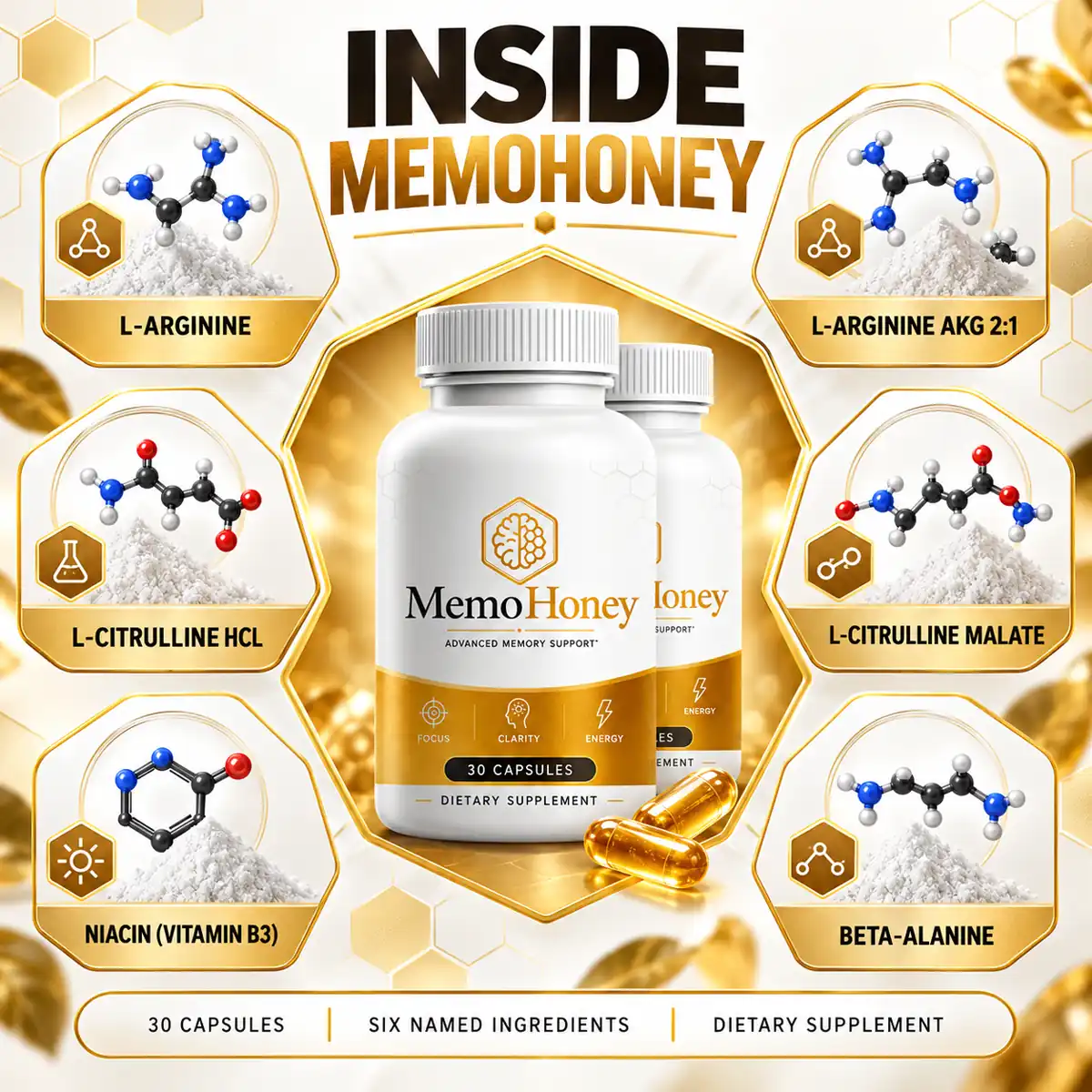
The inside panel names L-Arginine, L-Arginine AKG 2:1 Extract, L-Citrulline HCL, L-Citrulline Malate, Niacin (Vitamin B3) and Beta-Alanine. It does not print a Supplement Facts panel or a milligram amount for any of them. That means a shopper cannot tell from the pack how much of any named material is included in one capsule.
Unknown amounts also make research comparisons limited. A study can be useful for understanding what researchers tested, but it cannot establish what an unquantified formula delivers. The most honest comparison says only this: the study used a stated amount; MemoHoney's supplied label does not state an amount for the ingredient being compared.
- No product-specific clinical trial is supplied with this pack.
- No milligram amount is printed for any of the six named ingredients.
- No Supplement Facts panel or serving-size table is supplied.
- The direction is one capsule daily, preferably in the morning before a meal.
- A 30-capsule bottle describes the routine length, not the strength of the formula.
Ingredient research is not product research
There is published beta-alanine research that measured cognition, and that is worth describing accurately. The 2023 trial on this site's reference list studied older adults and used 2.4 grams daily for ten weeks. The follow-up literature has its own limits, populations and measures. It is not a MemoHoney study, and it does not reveal how much beta-alanine this bottle contains.
Several other named ingredients have a history in nitric-oxide, circulation or sports supplement contexts. A mechanism or a result in that setting should not be silently translated into a memory conclusion. The wider review literature on over-the-counter memory supplements also gives buyers a reason to prefer disclosed formulas and a careful separation of marketing from evidence.
| Evidence question | What the cited record can say | What it cannot say about MemoHoney |
|---|---|---|
| Beta-alanine cognition trial | A stated 2.4 g/day, 10-week study in its own participants | That MemoHoney supplies 2.4 g/day or reproduces the result |
| Ingredient mechanism | Why researchers tested a material in another context | That the complete MemoHoney blend changes memory |
| Product label claim | How the seller describes the category | The size or likelihood of a user outcome |
| Consumer guidance | Questions to ask before using a supplement | A substitute for individual medical advice |
A comparison stays useful only when the formula, amount, population and outcome are kept visible.
A better way to read the word support
For this product, read support as a label-level statement rather than as a personal forecast. It can prompt a buyer to ask what the product contains, what the directions are and where the supporting information comes from. It cannot answer how a person's memory will change, or whether a new symptom has a cause that needs care.
That boundary is particularly important for cognition. Sleep disruption, depression, thyroid disease, B12 deficiency, hearing loss and medication effects can all appear as forgetfulness. A supplement label is not a screening tool. New, worsening or concerning changes in memory deserve a conversation with a qualified health professional rather than a longer experiment with a bottle.
- Read the product phrase, then find the concrete facts beside it.
- Look for a Supplement Facts panel, serving size and amount per ingredient.
- Compare a study's dose and population with the actual product, only when both are known.
- Keep medication and health-history questions for a clinician or pharmacist.
- Use a return policy as a commercial term, not as evidence that a product will work.
It does not say MemoHoney improves memory, concentration, energy or any medical condition. The supplied pack supports a label claim, not a clinical outcome.
Make a purchase decision from disclosed facts
A fair decision can be quite simple. MemoHoney provides a 30-capsule, once-daily routine, six named ingredients and a 60-day money-back guarantee in the seller's terms. It does not provide a milligram disclosure, a Supplement Facts panel or a clinical trial of the finished formula in the material available to this desk. Those are meaningful limits, not small print to solve with a more confident slogan.
If the disclosed information is sufficient for your standards, use the official purchase terms and retain your order details. If you need a quantified formula, a finished-product test report or a product trial, the current supplied pack does not meet that request. Choosing not to fill an evidentiary gap with optimism is a valid buyer decision.
Check the MemoHoney facts before ordering
Review the official product information, the one-capsule daily direction and the 60-day money-back terms. A label claim should be weighed with the facts the label actually discloses.
Two bottles $158 · six bottles $294 · 60-day money-back guarantee
Order MemoHoney On The Official WebsiteOne capsule a day · 30 per bottle · lot MEM-26/ME-7725
The facts to compare before relying on a claim
A useful product comparison puts like beside like. Compare the front-label phrase, the serving direction, the ingredient names, the disclosed amounts, the form of any evidence and the terms of purchase. If one product gives amounts and another does not, that is a meaningful distinction on its own. It is not solved by treating a stronger sounding claim as though it supplied a missing measurement.
The word advanced can sound as if it ranks a formula above alternatives. On the supplied MemoHoney pack it is part of the product name and category presentation. It does not state a technical standard, a laboratory method or a comparison against another formula. A reader should ask what has been advanced in a concrete sense: the ingredient dose, the finished-product evidence, the publication date, or only the headline language.
This is also why an exact date matters. A seller's price, pack options and return terms can change, while a literature citation describes a particular study at a particular dose. Keep each fact in its proper place. The current seller information can guide a purchase decision; it cannot rewrite a trial's population or supply a quantity absent from the bottle.
When a memory concern is the real reason for shopping, make the health question primary. Cognitive changes are often worth assessing for causes that a supplement marketing claim cannot identify. That does not make a buyer irrational for reading a label; it makes the label one small source of information rather than the entire decision.
The same disciplined comparison applies to online reviews and summary pages. A reader can note that another customer liked a routine, but cannot turn an anecdote into an ingredient amount or a controlled outcome. Ask whether the account identifies the exact product, the duration, the relevant facts and a realistic alternative explanation. If it does not, it may be useful as a personal story but not as a basis for a medical or efficacy conclusion. Read it with the same care as any other claim.
- A phrase such as Advanced Memory Support identifies a marketing category, not a measured outcome.
- A named ingredient is not a disclosed dose.
- An ingredient study is not a trial of an undisclosed blend.
- A money-back term is a commercial policy, not evidence of efficacy.
- A clinician or pharmacist is the appropriate source for medication compatibility and new symptoms.
MemoHoney is a dietary supplement and not a treatment for anything. Memory that has changed in a way you or the people around you have noticed deserves assessment: thyroid disease, B12 deficiency, depression, sleep apnoea, untreated hearing loss and several ordinary prescriptions all present as forgetfulness and all of them are treatable. These statements have not been evaluated by the Food and Drug Administration.
References
- Hersant H, He S, Maliha P, et al. Over the Counter Supplements for Memory: A Review of Available Evidence. CNS Drugs. 2023;37(9):797-817. PMID 37603263. https://pubmed.ncbi.nlm.nih.gov/37603263/
- Ostfeld I, Ben-Zeev T, Zamir A, et al. Role of beta-Alanine Supplementation on Cognitive Function, Mood, and Physical Function in Older Adults; Double-Blind Randomized Controlled Study. Nutrients. 2023;15(4):923. PMID 36839281. https://pubmed.ncbi.nlm.nih.gov/36839281/
- Church DD, Hoffman JR, Varanoske AN, et al. Comparison of Two beta-Alanine Dosing Protocols on Muscle Carnosine Elevations. J Am Coll Nutr. 2017;36(8):608-616. PMID 28910200. https://pubmed.ncbi.nlm.nih.gov/28910200/
- Using Dietary Supplements Wisely. National Center for Complementary and Integrative Health, National Institutes of Health. https://www.nccih.nih.gov/health/using-dietary-supplements-wisely
- Dietary Supplements: What You Need to Know. Office of Dietary Supplements, National Institutes of Health. https://ods.od.nih.gov/factsheets/WYNTK-Consumer/